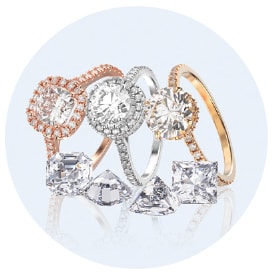
Choosing a diamond and its setting can be an exciting and sometimes confusing process. We can help you with these important decisions. Izzy Israeli, our diamond expert, takes pride in finding quality diamonds for his customers. He’s knowledgeable, accessible and happy to explain diamond credentials, as well as show you a selection of diamonds in a range of prices.
While all diamonds are beautiful, only by comparing stones will you be able to appreciate what makes one more rare and valuable than another.
The 4 C’s
Although bigger may seem better, there are other important characteristics that combine to make up a diamond’s value. They’re called the “four C’s”:
- Cut,
- Color,
- Clarity, and
- Carat weight.
The better these four characteristics, the more valuable the diamond will be. You don’t have to be an expert to determine the quality of your diamond, but it helps to be informed. When you come to Atlanta Diamond Design, we’ll educate and guide you through the process of choosing that perfect diamond.
Cut
Nature determines a diamond’s color, clarity and carat weight. The cut of a master craftsman determines its brilliance and fire. To maximize this, the diamond cutter must place each of the stone’s facets and angles in exact geometric relation to one another.
The precision of the cut dictates the maximum amount of light the diamond will refract and reflect. If well-proportioned, light rays from all sides are bent towards the center of the stone and reflected (dispersed) back through the top (crown) in a display of sparkling flashes and rainbow colors. If the cut is too deep, some light escapes through the opposite side of the bottom (pavilion), and the center appears dark. With a too shallow cut light escapes through the pavilion before it can be reflected. The center will appear dark, watery and glassy.
Whatever the shape or size, the cut is the only human element. A diamond cut to good proportions will have more value than one which is not.
Color
Diamonds are found with a range of color, from faint yellow or brown through to the very rare pinks, blues, greens and other colors known as “fancies.” However, the best color for a diamond is no color – to allow light to pass effortlessly through and be dispersed in rainbows of color.
Although many diamonds appear colorless, the majority contain very slight traces of yellow, brown or gray. To determine the correct color, diamonds are compared to an internationally accepted master set of stones. The spectrum ranges from totally colorless, D, to light yellow, Z.
Even when a stone has a visible tint, such as K or above, it can still be very lovely if it has good clarity and cut. How the diamond is set can make a difference, too; you might not want to put a truly colorless diamond in a yellow gold setting since the yellow color will reflect in the stone. On the other hand, a slightly yellow stone will appear whiter in a yellow gold setting.
Clarity
Minute inclusions of other minerals trapped during the crystallization process result in nature’s birthmarks: tiny feathers and clouds that affect a diamond’s value. Large inclusions may interfere with the path of light cascading through a diamond.
A diamond’s clarity is determined by the number, size, type and placement of its inclusions. There are five clarity grades from “FL” (flawless) to “I” (imperfect).
A diamond is said to be “flawless” if no inclusions or external blemishes can be seen under a standard 10-power jeweler’s loupe. Truly flawless diamonds are extremely rare. A “VS2” (very slight inclusions) diamond is an exceptionally clean stone with no inclusions apparent to the naked eye.
Finding a diamond with minute inclusions can reduce the cost of the stone without detracting from its beauty or durability. The sparkle of an ideal cut can mask otherwise noticeable inclusions, and a mounting can cover hard-to-see pinpricks near an edge.
Carat Weight
The standard measure for diamond weight (and most other gems) is the “carat.” A carat is 200 milligrams and is divided into 100 “points.” For an unmounted diamond, carat weight is the easiest of the four C’s to determine.
Although the most obvious characteristic, carat weight is the least important in determining the brilliance and beauty of a diamond. However, size does increase the value of a good quality diamond for the simple reason that larger diamonds are found relatively infrequently in nature. And a bigger diamond shows off a stone’s color and cut to its best advantage.
Popular Diamond Shapes
Many people confuse cut with shape. While the cut is meant to reflect light, the shape often depends on the nature of the rough stone. Most shapes have little bearing on the stone’s value. The classic round brilliant, oval, pear, marquise, heart, emerald and princess shapes are among the most beautiful and popular today.
For another unbiased source, click here for information on diamonds from the Gemological Institute of America.